
 Share on Facebook
 Share on Instagram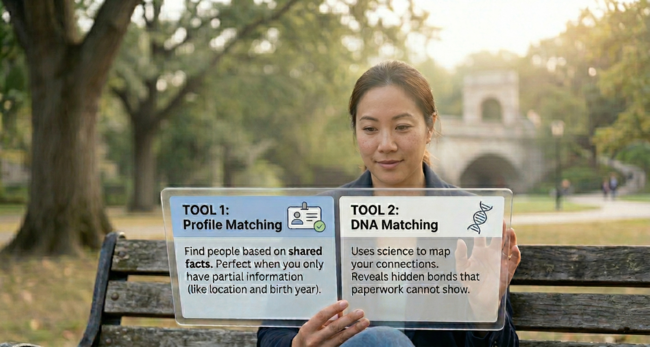
 1657
1657When you begin the search for your biological family, the biggest challenge is understanding which engine will actually drive you to your destination.
Many people start their journey on general genealogy sites, only to realize those platforms aren't specifically designed for the complexities of adoption.
At Adopted.com, we bridge that gap by offering two distinct, powerful tools: Profile Matching (the core of a mutual consent registry) and DNA Matching (the science of genealogy).
While both serve the same goal of reconnection, they function very differently. One relies on the shared facts of your history, while the other relies on the building blocks of life. Let’s break down how they work and why using both together can be an effective strategy for a successful reunion.
1. Profile Matching: The Power of Mutual Consent
A Profile Match is the heartbeat of a mutual consent registry. Unlike a general search engine, it is designed to find two people who are both actively looking for each other. When you sign up, you answer 10 specific questions designed to narrow down the search field, such as your year and month of birth, country, and gender.
The Strength of Numbers
The effectiveness of a registry relies entirely on the scale of its community. With millions of people in the Adopted.com database, we host the largest adoption registry in the world. This is a critical advantage: the more people who join, the more "missing pieces" find their fit. Whether you are a birth parent searching for a child or an adoptee looking for your roots, you are tapping into a global network of millions who have already raised their hand and said, "I want to be found."
Why a 9/10, 8/10, or even 7/10 Match is Still a Potential Breakthrough
One of the biggest hurdles in searching for your birth family is missing information. Human memory is fallible, and paperwork from decades ago can be inconsistent or even intentionally obscured.
Don't ignore a lower score match! Our proprietary matching algorithm highlights profiles that match most of your criteria even if they don't hit all 10. A partial match is often the breakthrough you've been waiting for because it accounts for:
-
Memory gaps: Decades can blur specific details like exact dates or specific hospital names.
-
Paperwork errors: Official records are not always 100% accurate, especially in older or international adoptions where transcription errors occur.
-
Amended Certificates: Adoptees were often given slightly different birth dates on their legal paperwork than what appears in hospital records.
2. DNA Matching: The Biological Blueprint
While Profile Matches use historical data, DNA Matching compares your genetic code, the literal manual that built you. This is the tool most commonly associated with genealogy sites, but it serves a very specific purpose here too.
The Science of Connection
By using DNA data (often uploaded from services like MyHeritage, AncestryDNA or 23andMe), our system looks for shared segments of DNA. Because you inherit exactly 50% of your DNA from each parent, the science is indisputable.
-
Centimorgans (cM): This is the unit used to measure genetic linkage. The more cM you share with someone, the closer the relationship. For example, a match of 3,500 cM usually indicates a parent, while 1,700 cM might be a full sibling.
-
The "Secret" Map: DNA can reveal connections that paperwork cannot, such as finding a half-sibling who was also placed for adoption but through a different agency or state.
The Sensitivity of DNA-Only Searches
While DNA is incredibly accurate, searching by DNA alone on general genealogy sites can be a sensitive, and sometimes risky, process. On those sites, you may match with a relative who has no idea a child was ever placed for adoption.
Reaching out via a DNA match can unintentionally expose a secret, leading to shock or even rejection. This is why we focus on preparing for your birth family reunion emotionally. Using our profile matches first ensures that the person you contact is also looking and emotionally prepared for the connection.
Why Use Both?
We recommend utilizing both tools in tandem. A Profile Match tells you that the other person is ready, willing, and waiting to be found. This is a vital tool, especially when DNA testing alone may not be enough to bridge the gap. DNA Matching then acts as the final key in the lock.
By combining the facts of your past with the truth in your DNA, you create the strongest, most respectful, and most successful path toward a heartwarming reunion. Learn more about DNA in our DNA Guide
Ready to see who is searching for you? Register your free profile today.


